
Google Antigravity vs. OpenAI Codex: Everything You Should Know (Features, Pricing & More)

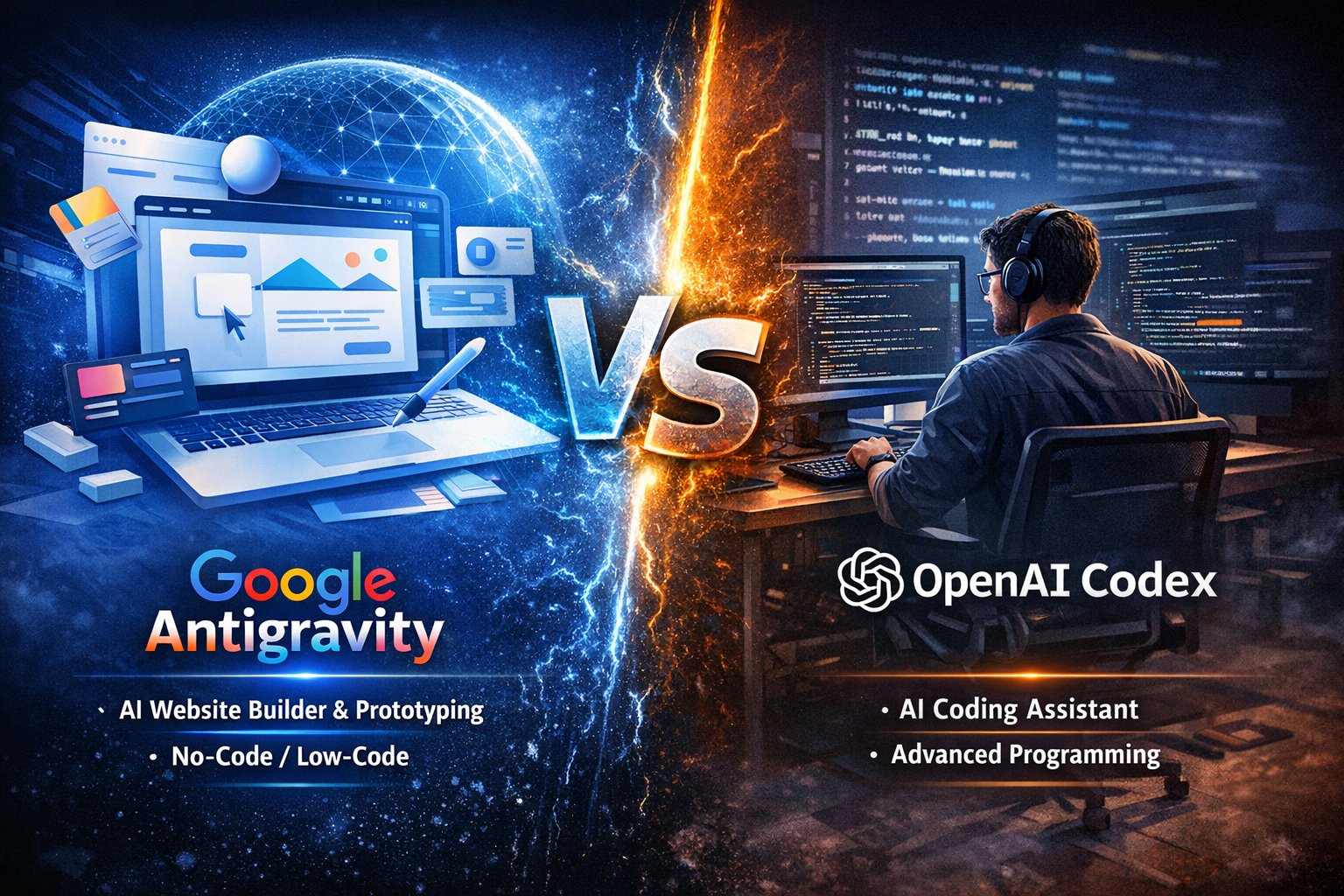
Artificial Intelligence is rapidly transforming how software is built. Two emerging tools gaining attention among developers and tech enthusiasts are Google Antigravity and OpenAI Codex. While both tools use AI to assist with coding and development tasks, they operate in different ways and target slightly different audiences.
In this article, we compare Google Antigravity vs. OpenAI Codex, explaining how they work, their key features, pricing models, advantages, and which one might be the better choice for developers in 2026.
What Is Google Antigravity?
Google Antigravity is an experimental AI development environment designed to help developers build websites, applications, and digital experiences using AI assistance.
The tool focuses heavily on AI-assisted development workflows, allowing users to generate code, design UI elements, and automate parts of the development process.
Developers can prompt the system to create components such as:
- websites
- frontend interfaces
- animations
- interactive layouts
Many developers use Antigravity for rapid prototyping and AI-assisted website building, especially when experimenting with no-code or low-code workflows.
Some tutorials show how Antigravity can build and deploy a website in minutes using platforms like GitHub and Vercel.
Key Features of Google Antigravity
- AI-assisted code generation
- rapid website prototyping
- automated UI generation
- integration with modern frontend tools
- no-code / low-code development capabilities
The goal of Antigravity is to allow developers (and even non-developers) to build applications faster using AI-driven workflows.
What Is OpenAI Codex?
OpenAI Codex is an AI model designed to help developers write, debug, and manage software code using natural language instructions.
Codex powers many AI coding tools and works as a virtual programming assistant capable of generating and editing code across multiple programming languages.
Codex can perform tasks such as:
- writing new code
- fixing bugs
- refactoring code
- generating tests
- reviewing pull requests
Unlike basic AI chatbots, Codex can interact with development environments and execute coding tasks autonomously, making it closer to a coding agent than a simple assistant.
It is widely used by developers who want an AI system that can assist with real software engineering workflows.
Key Features of OpenAI Codex
Codex includes several powerful capabilities designed specifically for professional developers.
1. Natural Language Programming
Developers can describe a task in plain English and Codex will generate the corresponding code.
Example:
“Create a login system with JWT authentication.”
Codex can automatically generate the code for that feature.
2. Multi-Language Support
Codex supports multiple programming languages including:
- Python
- JavaScript
- TypeScript
- Go
- Java
- C++
3. Code Debugging
Codex can analyze existing code, detect errors, and suggest improvements.
4. Automated Development Tasks
Codex can perform engineering tasks like:
- writing unit tests
- renaming variables
- refactoring large codebases
- running automated checks
OpenAI describes Codex as a coding collaborator that can work alongside engineers on real software projects.
Pricing: Google Antigravity vs. OpenAI Codex
Pricing structures for the two platforms differ significantly.
OpenAI Codex Pricing
Codex is available through ChatGPT subscription plans and developer APIs.
Typical pricing tiers include:
| Plan | Price |
|---|---|
| Go | $8/month |
| Plus | $20/month |
| Pro | $200/month |
| Business / Enterprise | Custom pricing |
The Pro plan allows significantly higher usage limits for developers who rely heavily on AI coding tools.
API Pricing Example
For developers integrating Codex via API:
- about $1.25 per million input tokens
- about $10 per million output tokens depending on the model.
There are also lighter models such as Codex Mini with lower costs.
Google Antigravity Pricing
Google Antigravity pricing varies depending on the platform integration and subscription model.
In many setups, Antigravity tools are offered through AI development subscriptions or experimental programs, sometimes bundled with other Google AI tools.
Pricing may include:
- free experimental access
- developer subscription tiers
- usage-based cloud computing charges
Because Antigravity is still evolving, pricing models may change as Google expands the platform.
Google Antigravity vs. OpenAI Codex (Feature Comparison)
| Feature | Google Antigravity | OpenAI Codex |
|---|---|---|
| Primary Focus | AI website and app building | AI coding assistant |
| Target Users | Developers and creators | Professional developers |
| Code Generation | Yes | Yes |
| Bug Fixing | Limited | Advanced |
| Autonomous coding tasks | Limited | Yes |
| Multi-language coding | Moderate | Extensive |
| API for developers | Limited | Full API support |
Which One Is Better?
The best option depends on your goals.
Choose Google Antigravity if you want:
- quick website prototypes
- AI-generated interfaces
- no-code development tools
- creative AI experimentation
Choose OpenAI Codex if you want:
- serious software engineering support
- automated coding tasks
- debugging and testing assistance
- AI integration into development pipelines
In simple terms:
- Antigravity = AI development environment
- Codex = AI programming assistant
The Future of AI-Powered Development
The competition between companies like Google and OpenAI is accelerating the evolution of AI coding tools.
Industry experts believe that AI coding assistants will soon become standard tools for software developers, helping teams build applications faster and with fewer errors.
Tools like Codex and Antigravity demonstrate how AI can:
- automate repetitive programming tasks
- accelerate software development
- lower the barrier to entry for building applications
Final Thoughts
Both Google Antigravity and OpenAI Codex represent the next generation of AI-powered development tools.
While Antigravity focuses more on creative application building and rapid prototyping, Codex is designed to act as a full-fledged AI coding assistant capable of collaborating with developers on complex software projects.
As AI continues to evolve, developers will likely combine multiple AI tools to improve productivity and speed up development workflows.

